
July 2026
Why Bosses Exist
I built the digital army I'd been describing to myself for months, then sat down at the desk and got bored anyway. Which forced a stupid question: why do bosses exist at all?
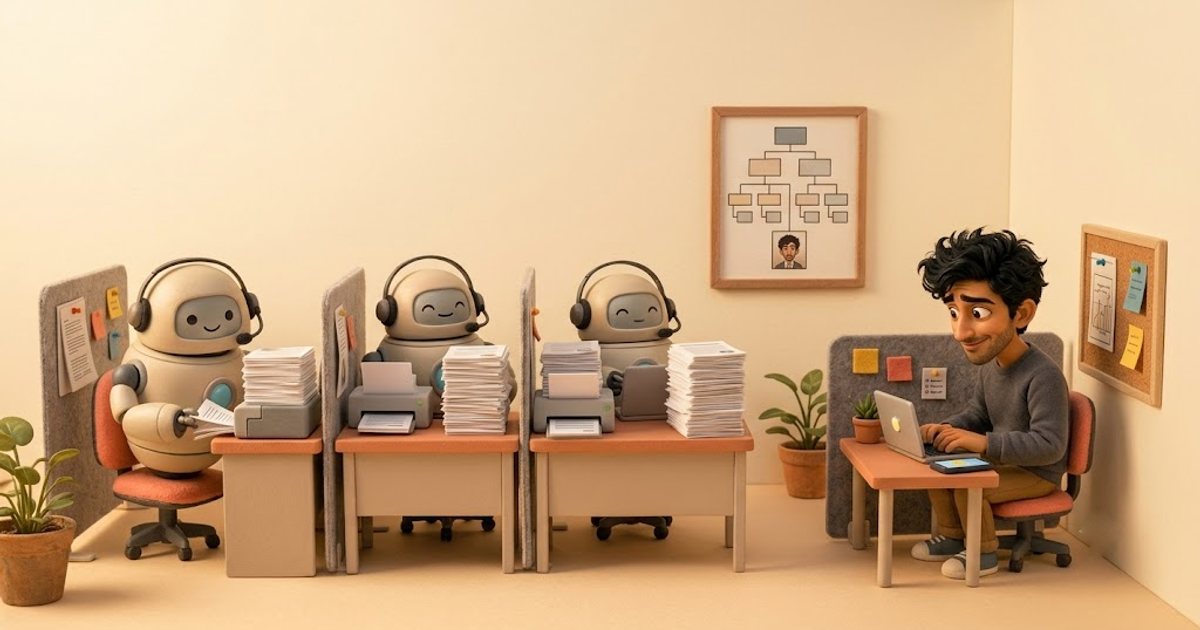
I built the thing.
That’s the part that makes this embarrassing. This isn’t a “someday the tools will let us” post. The tools let me. I sat down over a few weekends and built the exact system I’d been describing to myself for months. A cockpit. It has boards, it has skills, it dispatches agents, it updates itself while I sleep. It has a name. It is, more or less, a small company that happens to have no people in it.
And this morning I opened my laptop, sat at the desk, and got bored within about eleven minutes.
So I have the army. That was supposed to be the hard part. A digital army of employees, basically available, basically free, waiting to be pointed at something. And here is the founder of this army, sitting very still in a chair, checking the same apps in rotation, waiting for a bar to fill, feeling exactly like I felt back when the work was mine to grind through by hand.
Which made me ask a stupid question I couldn’t answer. Why do bosses exist?
Not the flattering version. The real one. We tell ourselves managers exist for coordination, vision, leadership, some noble organizing function. Maybe. But I think the quieter truth is this: at some point somebody decided they did not want to be the one sitting at the computer all day, and they arranged for other people to do that part. That’s a lot of what management actually is. A successful escape from the desk. The boss is just the person who stopped being the employee and got someone else to hold the chair.
And for most of history that was a slightly ugly deal, because the someone else was a person. Who also didn’t want to sit there. Who was doing it for the money and would rather have been somewhere else too. The whole arrangement ran on the fact that not everyone gets to leave the chair.
That part just changed.
The someone else isn’t a person now. It’s the army. It doesn’t mind the chair. It doesn’t get bored, doesn’t check WhatsApp, doesn’t resent me for leaving. It just sits at the computer all day doing the thing nobody ever wanted to do, which turns out to be the only version of this deal that was ever actually fair.
So I have staff. I have the exact thing the desk was always secretly about escaping. And I am still, every morning, volunteering to be the employee. The technician. The guy on the tools.
I’m the most over-resourced junior in the building. I run a company of tireless workers and then insist on doing the intern’s job myself, badly, while bored.
The fix is dumb and physical. Put the laptop down. Walk around. The system already knows how to reach me. It pings when it genuinely needs something, I talk into my phone, the words become instructions, the instructions go to the workers, and I keep walking. I’ve started calling it dispatch, which sounds grander than it is. It’s just me, outside, saying “do this” into a phone, the way a boss does, instead of sitting in the chair doing it.
Getting there wasn’t the romantic part. A voice note is a useless instruction on its own. “Do this” only works if the company already knows everything I’m not saying: what we’re building, what’s been decided, what the goals are, which tools it’s allowed to touch, how we do things around here. That took months to get right, and it’s the unglamorous reason any of this works. The boss’s sentence gets to be short because the company’s context is long. Every real company runs on this. Nobody writes it on the wall.
And the strange thing is the clarity gets better, not worse. Walking around, I actually think. At the desk I mostly wait. The good instructions, the sharp “no, not like that,” the decisions worth making, they tend to arrive when I’m moving, not when I’m marinating in a chair watching a progress bar.
There’s an obvious next question, and I don’t have the answer. If the system holds the goals and the context and the memory, why am I in the loop at all? It could decide what to dispatch itself. Maybe one day it will. For now I keep a hand on the decisions, and I genuinely can’t tell you whether that hand is judgment or just the last piece of the chair I’m refusing to give up. Who knows yet.
I’d love to end there. Enlightened man, phone in pocket, dispatching wisdom from a park bench while his little empire hums.
But I keep opening the laptop.
The chair has gravity. Knowing why bosses exist and actually being able to leave the desk are two completely different things, and I only figured out the first one. The system is ready to be run from a pocket. I’m the part that isn’t ready. Some old program still believes the sitting is the work. That if my hands aren’t near the keyboard, I’m getting away with something.
So there’s one more employee I have to manage out of the building before any of this works.
It’s me. I’m the employee. The biggest constraint in the company, and the only one I can’t dispatch.